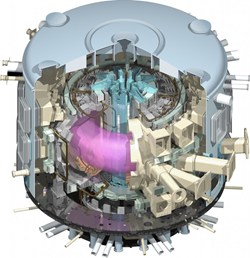
International Thermonuclear Experimental Reactor (ITER) is an international controlled nuclear fusion research and engineering project, which is currently building the world's largest and most advanced experimental tokomak at Cadarache in the south of France. The ITER project aims to make the long-awaited transition from experimental studies of magnetic confinement of plasma to achieve fusion to full-scale electricity-producing fusion power plants. The project is funded and run by seven member entities — the European Union (EU), India, Japan, the People's Republic of China, Russia, South Korea and the United States.
The ITER fusion reactor has been designed to produce 500 megawatts of output power for 50 megawatts of input power, or ten times the amount of energy put in (i.e. Q≥10). The machine is expected to demonstrate the principle of getting more energy out of the fusion process than is used to initiate it, something that has not been achieved with previous fusion reactors. The first commercial demonstration fusion power plant, named DEMO, is proposed to follow on from the ITER project to bring fusion energy to the commercial market. India is actively involved in fusion research and building its own fusion reactor spearheaded by Institute for Plasma Research, Gandhinagar, India.